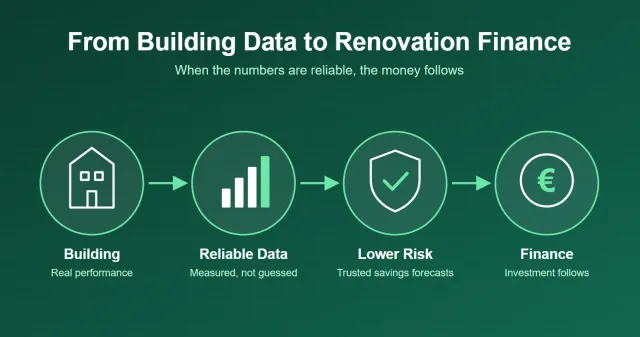
In today's context, Europe needs to renovate its building stock faster. According to the European Commission, buildings are the EU's single largest energy consumer, accounting for 40% of EU energy consumption and 36% of energy-related greenhouse gas emissions.
The recast Energy Performance of Buildings Directive (EU) 2024/1275 is raising expectations for every owner, from households to public authorities. It entered into force in May 2024 and had to be transposed into national law by 29 May 2026, so the pressure is now on Member States to deliver.
The technologies needed for deep renovation already exist: better insulation, heat pumps, solar panels, battery storage and smart controls. What often holds projects back is a lack of reliable data, and therefore a lack of confidence among building owners, ESCOs and lenders, who need pre and post implementation reliable data before committing to finance such projects.
This is where reliable building data becomes more than a technical detail. It becomes a financial asset and necessity.
The problem: uncertainty has a price
When a bank or investor looks at a renovation project, they ask a simple question: will this investment pay for itself? For an energy renovation, the answer depends on the savings the upgrade will deliver year after year, and on the factors that sustain them over time: the quality of the service, proper maintenance and the client's satisfaction with the service provided.
Too often, those savings are estimates based on generic assumptions, old energy performance certificates or incomplete information about how the building is really used. The difference between predicted and actual savings is known as the "performance gap", and financiers know it well.
Uncertainty affects financing terms in very practical ways. Lenders may ask for higher interest rates to cover the risk, require higher equity, collateral or guarantees, or costly performance insurance, offer smaller loan amounts or shorter repayment periods, ultimately simply decline projects that look too hard to assess. Small projects suffer most, because the cost of a detailed assessment can be too high compared with the size of the loan. The result is that many worthwhile renovations never get started.
The solution: data that financiers can trust
Reliable, well-structured building data changes this picture. When energy consumption is measured rather than guessed, and when savings forecasts are based on real performance, the risk becomes something that can be understood and priced accordingly.
Reliable data helps at every stage of a project.
Before the renovation, a clear picture of the building's current consumption makes it possible to identify the measures that deliver the biggest savings for the money and are easiest to finance. A project with a credible baseline and a realistic savings forecast is far easier to present to a lender.
During the decision, AI-based tools can compare scenarios quickly, showing how different packages of measures affect energy bills, payback period, comfort levels and emissions. This lets building owners, energy service companies (ESCOs) and financiers talk about the same numbers.
After the renovation, monitoring shows whether the promised savings are really being delivered. Verified results build trust, support performance-based models such as Energy Performance Contracting (EnPC) and Energy-as-a-Service (EaaS), and make it easier to finance the next project.
Why this matters for finance
For the financial sector, trustworthy building data opens several doors.
It supports green mortgages and green loans, where better funding terms are offered for energy-efficient properties. It makes Energy Performance Contracting and EaaS more attractive, because savings and performance can be measured and verified. It helps banks meet and report on their ESG and EU Taxonomy obligations, which require evidence of the environmental performance of the assets they finance. And it allows many small projects to be aggregated into larger portfolios, reaching a size that interests institutional investors.
In short, data turns renovation from a guesstimate into an investment case.
LiveBetter's contribution
The LiveBetter project, funded under the EU LIFE programme, is developing AI-powered services that turn building data into renovation action plans. A key part of this work is making data from different sources "speak" the same language, so that information is consistent, comparable and reliable.
Just as importantly, LiveBetter is designing its services together with the people who will use them, through Business Cases across Europe. This ensures that the tools answer real needs and address real barriers, including those faced by the owners and financiers who must make investment decisions.
As the consortium partner focused on sustainable finance, EnerSave Capital Sarl helps to connect these data services to the way banks, investors and funding programmes actually assess projects. Our goal is simple: when LiveBetter's tools say a renovation makes sense, that message should be clear, measurable and credible to the people who can finance it.
Looking ahead
In its Renovation Wave strategy (Renovation Wave Communication (COM/2020/662)), the European Commission estimated that around €275 billion of additional investment per year is needed to reach the EU's 55% climate target by 2030. Europe's renovation wave will therefore not be financed by public money alone. Private capital is available and increasingly looking for sustainable investments, but it needs confidence. Better and reliable building data is one of the most effective ways to provide it.
When the numbers are reliable, the money follows. And when the money follows, more buildings become sustainable, warmer, cheaper to run and better for the planet.