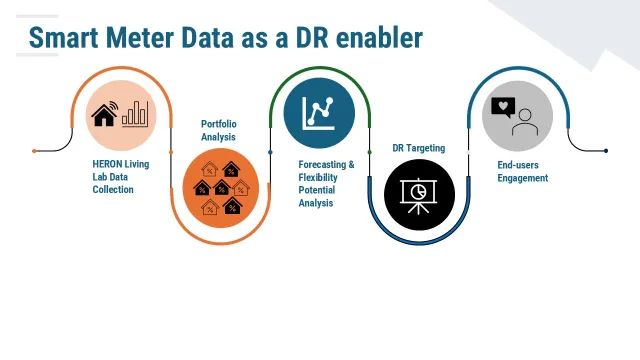
A single household shifting its dishwasher cycle by an hour makes almost no difference to the electricity grid. Thousands of households doing the same thing, at the right moment, can act like a small energy provider to the grid. Turning many small, scattered actions into one reliable resource is the job of an aggregator, and smart meter data is what makes that job possible.
What does an aggregator actually do?
An aggregator brings together the flexibility of many small consumers, such as households, and offers it to the energy system as a single, manageable resource. That flexibility can help reduce demand peaks, balance supply and demand in real time, and make better use of renewable energy when it is abundant.
As European electricity markets open up to demand-side participation, this role is becoming increasingly important. Households are no longer only consumers of energy. They can become active participants in keeping the system stable, affordable and clean.
Why a utility talks about aggregation
For a utility like HERON, aggregating the household flexibility is a natural extension of serving customers. It adds value to the energy system while opening new ways for households to benefit from how and when they use energy. Aggregation is a business model, where suppliers and energy providers in general bring a real advantage to it: an existing, everyday relationship with their customers, built on trust though. That matters, because flexibility depends as much on people as on data.
What smart meter data makes possible
For an aggregator, smart meter data is far more than a number on a monthly bill. It is the foundation for four essential capabilities:
- Knowing the portfolio. Analysis on the detailed consumption data reveals households profiling and flexibility potential. In simple words, when and how much households can adjust their energy use. This way helps distinguish a family with an electric vehicle from a single pensioner living in an older apartment, since each offers very different flexibility.
- Forecasting. Reliable flexibility starts with a reliable prediction of the baseline energy consumption. Granular data allows aggregators to estimate both the expected demand and the flexibility available.
- Verification. When a household is asked to reduce or shift energy consumption, the aggregator must prove that the change actually happened. This requires an accurate baseline of what would have occurred otherwise, which in turn depends on high-quality metering data.
- Targeting. Instead of asking everyone, every time, data allows aggregators to address the households most likely and most able to respond. This improves results and avoids overwhelming people with requests.
The catch: data is necessary, but people make decisions
There is one thing smart meters cannot measure, and this is willingness. Household flexibility is ultimately a human-dependent resource, shaped by daily routines, comfort expectations and personal priorities. If requests are too frequent, badly timed or poorly explained, engagement quickly fades, and with it the flexibility the aggregator depends on.
Trust is equally important. People need to understand why they are being asked to act, how their data is used, and what they gain in return. Comfort and wellbeing cannot be treated as an afterthought as they determine whether households stay involved over time.
This is exactly where LiveBetter's focus on wellbeing and engagement becomes highly relevant for aggregators. Designing flexibility around people’s lives is what turns flexibility from a concept into a dependable resource.
What HERON is learning through LiveBetter
Within LiveBetter, the HERON’s Living Lab operates with real households in Greece located mainly in Attica region. This setting allows to explore how different household profiles translate into available flexibility, how people respond to requests to shift their consumption, and how energy services or tariffs can be designed to be both reliable for the energy system and acceptable for the people taking part.
The aim is to bridge two perspectives that are often treated separately, the technical and market view of the aggregator, and the everyday experience of the household.
Why it matters now
As renewable energy grows and electricity markets evolve, flexible demand is becoming a key part of the energy transition. European policy is increasingly opening the door for aggregators towards demand response, and smart metering provides the data needed to actively participate in flexibility services.
The aggregators to ensure the highest possible outcome must understand both the data and the people behind it. Smart meters tell us how much energy a home uses, however, understanding the people inside tells us how much flexibility that home can truly offer.