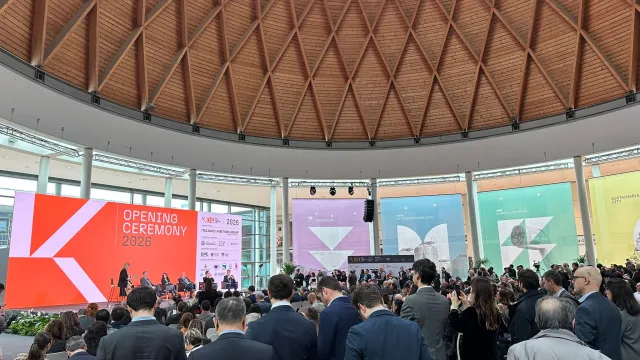
LiveBetter was presented at KEY Energy 2026, one of Europe’s leading events dedicated to energy transition, during the session “Artificial Intelligence supporting the decarbonisation of the built environment”, held at the City&Mobility Arena.
Chaired by Prof. Gian Marco Revel (Università Politecnica delle Marche), the session brought together a distinguished panel of speakers from across the building and energy ecosystem, including representatives from ANCE, Veolia, Siemens, and the University of Perugia. Their contributions provided a comprehensive overview of the challenges and opportunities linked to the digital and sustainable transformation of the built environment.
The discussion revolved around a question that is rapidly moving to the centre of the European agenda: how can Artificial Intelligence concretely accelerate the decarbonisation of buildings and cities?
Across the different interventions, a clear message emerged. While technologies are advancing at an unprecedented pace, the real challenge is no longer just technological innovation, but the ability to transform data into reliable knowledge, and knowledge into real decisions and investments.
A particularly insightful moment of the session emerged from the comparison between the regulatory perspective and concrete industrial applications. ANCE outlined a long-term strategy aimed at enabling a true digital transition of the construction sector, focusing on connecting the needs of the entire value chain with the digital skills available at territorial level. This approach also emphasises the importance of experimenting with innovative technologies to improve process efficiency and promote sustainable development across the sector.
In parallel, industrial players such as Veolia and Siemens demonstrated how these principles are already being translated into practice. Veolia presented integrated solutions combining energy services and data-driven management of buildings and infrastructures, while Siemens highlighted the role of AI-powered digital platforms not only at building level, but also at urban scale, enabling more efficient management of districts, infrastructures and energy systems. These contributions showed how Artificial Intelligence is already supporting operational decision-making and optimising performance across multiple scales.
This exchange highlighted a key point: while the regulatory framework is setting the direction and industry is deploying concrete solutions, there is still a need for structured approaches capable of connecting these dimensions and enabling their large-scale adoption.
In this context, the LiveBetter project was introduced as a concrete European response to this challenge. Presented by Serena Serroni (MoS), LiveBetter is developing a new generation of digital solutions capable of transforming fragmented and often unreliable building data into actionable insights for renovation.
“Today, the challenge is not the lack of data, but the lack of trusted and usable data. LiveBetter addresses this by turning fragmented information into reliable insights that can actually drive renovation decisions.”
Rather than focusing on a single tool or application, LiveBetter proposes a systemic approach. At its core is the development of a Common European Digital Buildings Hub, designed to connect high-quality data, Artificial Intelligence and advanced services into a unified environment. This enables stakeholders to better understand building performance, predict energy consumption, and identify the most effective renovation strategies.
The discussion highlighted how AI is already enabling a shift from static and theoretical assessments to dynamic, real-time evaluations of buildings. This evolution has important implications, not only for improving energy efficiency, but also for increasing trust in key instruments such as Energy Performance Certificates and for supporting financial decision-making. At the same time, one of the main barriers to large-scale renovation remains the availability of reliable, interoperable and accessible data. Without this foundation, even the most advanced technologies struggle to deliver real impact. By working on data quality, interoperability and integration across European initiatives, LiveBetter contributes to addressing this gap and supporting a more effective deployment of renovation strategies.
Participation in KEY Energy 2026 confirmed the growing relevance of Artificial Intelligence in shaping the future of the built environment. It also reinforced the importance of initiatives capable of bridging the gap between regulation, technology and market uptake.
By connecting data, AI and decision-making processes, LiveBetter contributes to advancing a more efficient, resilient and decarbonised built environment, supporting Europe’s transition towards climate neutrality.