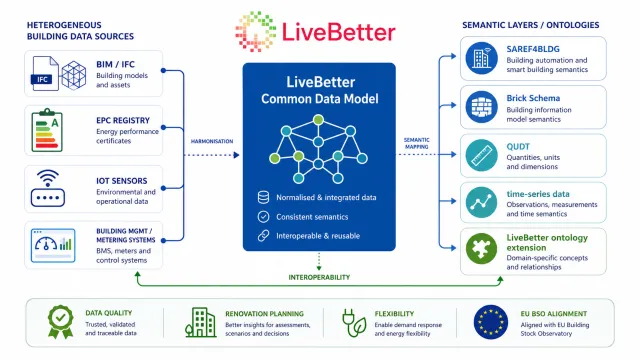
Within LiveBetter, data interoperability starts with a shared language. LiveBetter Common data model and harmonization blueprint, establishes this foundation by combining a project-wide Common Data Model with more specific ontologies that describe buildings, systems, meters, measurements, renovation measures and flexibility assets in a consistent way.
The value of this approach is practical as well as technical. Building information in Europe often comes from different sources and follows different structures, such as BIM/IFC files, EPC registries, metering systems and IoT platforms. By defining a common semantic layer, LiveBetter makes it possible to align these heterogeneous inputs and preserve their meaning across the project lifecycle.
At the centre of this work is the LiveBetter ontology, which extends established reference ontologies such as SAREF4BLDG and Brick Schema with LiveBetter-specific concepts. This allows the project to represent both static building characteristics and dynamic operational data, while also supporting renovation planning, data quality checks and flexibility-related use cases.
A key feature of this approach is that it does not force every partner to rewrite its data in a single rigid format. Instead, LiveBetter uses semantic mappings that connect native data structures to ontology terms, so that data can remain operationally usable while still carrying clear machine-readable meaning. This makes integration lighter for developers and more robust for downstream services along with the LiveBetter Hub Platform.
The ontology page also plays an important role in accessibility and reusability. It provides a clear view of the class hierarchy, properties and relationships, helping both technical teams and other stakeholders understand how the LiveBetter data model is structured. In practice, this supports implementation, documentation and future extension of the model as the project evolves.
By laying down these semantic foundations, LiveBetter strengthens interoperability, improves data quality and creates a more reliable basis for AI-based services, renovation workflows and data exchange with the EU Building Stock Observatory. It marks an important step towards a more connected and data-driven ecosystem for building renovation in Europe.