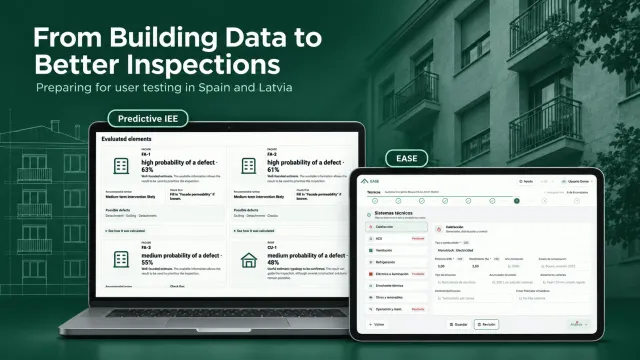
Every renovation decision rests on an assessment of the building. Before any measure can be designed, financed or approved, its construction, condition and energy use must be understood. That assessment usually depends on site visits, often carried out with limited prior information. Yet much can be known in advance: inspections of similar buildings reveal recurring defects, and available records document many of the property's construction and energy characteristics.
Integrating this prior knowledge into the inspection process is becoming increasingly important. The recast Energy Performance of Buildings Directive requires Member States to ensure that at least 55% of the decrease in the average primary energy use of the residential stock is achieved through the renovation of the 43% worst-performing residential buildings. This implies assessing a large number of properties rigorously and consistently. Within LiveBetter, Instituto Valenciano de la Edificación: IVE is preparing two complementary services that approach this challenge from different perspectives: the likely condition of the building and the documentation of its energy performance.
What previous inspections reveal
Buildings that share key characteristics tend to deteriorate in comparable ways. Construction period, façade and roof types, and exposure conditions are strong indicators of the defects that can be expected, and historical inspection records contain a substantial body of data on these patterns.
The Predictive Defect Identification Module (Predictive IEE) puts this accumulated experience at the inspector's disposal. Its name refers to the Spanish Building Evaluation Report (IEE), whose records form the basis of the service in Spain. Starting from a description of the building and its envelope, the service draws on comparable cases to point to the most likely defects. Each estimate is accompanied by information on the data that supports it, so that professionals can interpret the result and understand its limitations.
These estimates are a starting point, not a conclusion: professional judgement and on-site verification remain essential. What they offer is the chance to arrive on site with clearer priorities and more relevant questions.
A more consistent energy audit
On the energy side, the difficulty is different. An audit brings together information scattered across certificates, administrative records, utility bills and field observations, much of which is still transcribed by hand. Each transcription takes time, increases the risk of error and weakens traceability.
The Mobile and Online Software for Energy Audits (EASE) addresses this through a guided digital workflow. Information that is already available can pre-fill parts of the assessment, while structured sections help users complete and review data on the building envelope and technical systems. The aim is to reduce repeated data entry, make information gaps easier to identify, and document every audit according to the same criteria, providing a sounder basis for analysis and reporting.
Taken together, the two services connect the building's state of conservation with its energy performance: two dimensions that are usually analysed separately, but are best addressed together when planning a renovation.
Adapting to a new context
Knowledge drawn from past inspections is, by nature, rooted in a particular building stock. The trials in Spain and Latvia will therefore show to what extent the approach is transferable. The tools are being translated into English and Latvian, and work is under way to incorporate Latvian inspection records in order to check how they perform with a new dataset.
The adaptation, however, goes well beyond language. Construction practices, building typologies and the way inspections are documented vary from one country to another, and information may follow different classifications or come with uneven levels of detail. This work will help identify where terminology, field mappings or the methods themselves need adjustment.
The professionals' perspective
The planned user tests in both countries will examine how the tools fit into day-to-day practice. Their input will guide the next improvements and help distinguish shared needs from those that require local adaptation.
Why it matters
The success of renovation in Europe depends to a large extent on a link in the chain that is rarely visible: the quality of the initial assessment. The aim is not to replace professional judgement, but to ensure that it starts from a stronger evidence base and that site observations are recorded in a structured, comparable way. When what is already known about a building is connected with what is verified on site, each inspection stops being an isolated exercise and starts to inform better decisions: for those setting priorities, for those financing the works and, above all, for the people who live in the building.
A better-prepared inspection is, ultimately, a better-targeted renovation.